Showing posts with label Travel. Show all posts

Sunday, September 09, 2007

The Run Down, in Case You're Curious

My little Tanzanian adventure starts on September 14th when I depart Chicago for Kilimanjaro by way of Amsterdam. The flight to Holland takes about 8 hours, and then I have a solid 3 hour layover at Amsterdam-Schiphol. From there, it's another 8.5 hours south to the airport near Kilimanjaro. I land around 8 PM local time (GMT+3) on Saturday, September 15th. Assuming my luggage arrives intact and on time, I board a shuttle to my hotel in Moshi, a smaller city near the mountain.

DAY 1 (Sunday, September 16th): The first day is mostly clear for chillin' and exploring Moshi. I'll probably hit up the sights, mosques, and whatever markets they have in store. Later in the evening, I have a pre-climb orientation session to meet the other climbers. A bit to my chagrin, my group ballooned to 15 climbers (I was expecting 12), exclusive of guides and porters. Bigger groups can get a bit unwieldy at 19,000 feet once you add the support staff. I'm guessing around 40 porters (2.5 to 3 per climber) will help haul us and our gear up the mountain. Add in roughly three guides, and suddenly the "small group" hits nearly 60 people. The more climbers, the more potential problems. On the other hand, the more cool people I get to meet. My entire group (unfortunately) is from the States.

DAY 2 (Monday): Properly settled and oriented from the day before, we grab a quick breakfast before driving out to the remote Rongai route trailhead.

ASIDE: Kilimanjaro is by far the easiest of the Seven Summits to climb. In fact, over 20,000 people climbed it in 2000 alone. There are six ascent routes up the mountain, each with its relative merits. The Rongai route (also called Loitokitok or Nalemuru route) is by far the least traveled. Compared to the others, it’s harder to reach (the trailhead is on the north side of Kilimanjaro, furthest from the towns of Moshi and Arusha) and more expensive (as it’s further away). Since potable water is more scarce, porters must carry all that’s necessary (again adding cost and complexity). Also, given the trailhead’s close proximity to Tanzania’s northern border, the area is prone to occasional forays by opportunist bandits from Kenya who enjoy a little light larceny before slipping back into their homeland and out of Tanzania’s jurisdiction. To prevent such thievery, the Tanzanian government requires that armed guards accompany all groups starting up the Rongai route. By all accounts, however, neither guards nor bandits are ever seen on the mountain. And further decreasing the trail’s appeal, farmers have mostly denuded the bottom of Kilimanjaro around the trailhead, thus destroying any semblance of native flora and fauna.

The appeal of this route, however, is also rooted in its remoteness. Of the 20,000 Kili climbers in 2000, only 130 took the Rongai route. We’ll basically have the entire side of the mountain to ourselves. It’s a better adventure. And just in case you aren’t convinced, we descend the other side of Kilimanjaro, so we won’t miss anything on the other side. It’s the best of both worlds.

Back to Day 2. Depending on road conditions, the drive to the trailhead can take anywhere from two to four hours. After lunch, we start climbing. Day 2 takes us from the trailhead at 6,400 feet to Simba Camp at 8,500 feet. We start in cultivated farmland, pass through an alpine forest, and end up in a transitional heather zone. Climb: 2-4 hours, 2,100 foot gain.

DAY 3 (Tuesday): With enough altitude beneath us, the morning should hopefully bring a spectacular sunrise over the Kenyan savannah. I’m not sure what time we hit the trail, but the morning portion of the climb is long and hard. We gain 2,600 feet over a four hour trek through heather and moorland (boring) before stopping for lunch. In the afternoon, the trail flattens out up to Kikelewa Camp at 11,500 feet. Climb: 6-8 hours, 3,000 foot gain.

DAY 4 (Wednesday): Thankfully, Day 4 is much easier than Day 3. By morning’s end, we reach the base of Mawenzi Peak, one of two peaks on Kilimanjaro. Mawenzi is more jagged, more technical, and lower than Kili’s summit at Kibo Peak (our destination), and therefore we don’t bother with it. We break for lunch at Mawenzi Tarn (14,000 feet), and then we take an acclimatization hike to work through the side effects of altitude sickness. In addition to the hike, I’ll be on Diamox to help get acclimatized, and I’ll be forcing fluids, too (6 liters a day). Climb: 3-4 hours, 2,500 foot gain.

DAY 5 (Thursday): At this point, there are no easy days. The air is seriously thin. In the morning, we leave camp a little earlier to trek toward the saddle between Mawenzi and Kibo peaks. At one point along hike, we can look out over Kenya to the north and Tanzania to the south. With Kili’s summit in the background, the trail to the high camp will stretch out before us. Our destination for the day, Kibo Hut, sits at 15,500 feet, and we reach it early afternoon. The rest of the day and evening is spent conserving strength and eating. I go to bed super early. Day 6, summit day, is looooong. Climb: 4-6 hours, 1,500 foot gain.

DAY 6 (Friday, September 21st): SUMMIT DAY! But before you get too excited, listen to this. We wake up at 11 PM on Day 5 to prepare for our summit bid. At midnight, we leave camp, slowly climbing for the first time under our headlamps. In the early morning hours, we hit Gilman’s Point on the Crater Rim at 18,600 feet. The route will take us through a scree field laced with 37(!) switchbacks. With luck, we catch the sunrise from Gilman’s Point before trekking another 90 minutes along the rim to Uhuru, the roof of Africa, at 19,340 feet. I’ll dance and sing or maybe just collapse, but regardless we have only 20 or 30 minutes at the peak before we have to head back down. Our initial descent to Kibo Hut takes about 4 hours. By then, it’ll be early afternoon, so we have a light lunch and then catch the Marangu route to Horombo Camp at 12,200 feet. Basically, we fall down the mountain. My knees will want to kill me. Climb: 13-16 hours, 3,800 foot gain followed by a 7,100 foot descent.

DAY 7 (Saturday): We sleep in. A long time. And then we eat a giant breakfast. No longer dead, we fall another mile or so to the Marangu route trailhead at 6,400 feet. This day should be relatively easy, all things considered, and filled with expansive, stunning vistas of the Tanzanian savannah. Once at the trailhead, we drive 90 minutes back to Moshi, our hotel, and my first hot shower in a week. I may or may not snag a quick nap before cracking my first beer at the celebration dinner during which I’m bound to forget my name, where I am, and how to walk. Climb: 4-5 hours, 5,800 foot descent.

DAY 8 (Sunday, September 23rd): PARTY! I finally get to chill in Moshi. Not sure what the day will entail, but I’m sure I’ll spend some money in overpriced tourist traps, drink piss for beer, and meet at least six crazy Aussies, three Kiwis, and two creepy Germans.

DAYS 9 and 10 (Monday and Tuesday): My safari begins! Our first destination is Tarangire National Park. We’ll take a few game drives and then a walk to get away from the vehicles. I’m liable to snap more pictures than a Chinaman with a brand new 12 megapixel Minolta. No, I’m not racist. I ROVE Asian tourists!

DAYS 11 and 12 (Wednesday and Thursday): We’re off to Serengeti National Park! It won’t be migration season, so I’ll miss all the sucker wildebeests getting munched by every living creature in Africa, but we’ll hopefully catch zebras, gazelles, lions, cheetahs, hyenas, elephants, baboons, hippos, crocs, and all sorts of hoofed mammals and crazy birds. It’s raw, unbridled, and unmitigated life all around us in one of the last truly wild places on Earth. Gnarly.

DAYS 13 and 14 (Friday and Saturday): On the way out of the Serengeti, we’ll stop at Olduvai Gorge in East Africa’s Great Rift Valley. This area is often called the ‘Cradle of Mankind’ (if not the ‘Cradle of Life’), because the earliest remains of Homo Habilis, among other hominid species, were discovered here in the 1950’s by Louis and Mary Leakey. Homo Habilis lived between 2.6 million and 1.5 million years ago, in case you were wondering. I think that’s awesome.

After Olduvai, we’ll head to Ngorongoro Conservation Area. More hikes and game drives follow, as the crater is home to perhaps the highest concentration of big game in the world. We’ll see huge herds of buffalo, zebra, and gazelle along with more lions, rhinos, elephants, and leopards. Groovy. My safari ends with a final game drive along the crater on Day 14.

DAY 15 (Sunday, September 30th): This is the final day of my trip. In the morning, I’ll take a morning cultural tour of traditional Masaai Boma where I can meet and interact with members of the Masaai tribe. Afterward, I’ll catch a ride back to a hotel for a quick shower and repack, and then I’m off to Kilimanjaro Airport. My flight departs at 8:55 PM local time. The plane will make a quick stop in Dar es Salaam before heading north to Amsterdam-Schiphol. Another layover, another flight, and I arrive back in Chicago at noon, one more country and one more adventure securely notched in my passport and belt. The End.

Friday, April 20, 2007

OK, but WHY?

So now that I've convinced most of you that I'm serious about this trip, the inevitable follow-up is "WHY?!?" I'm not sure I have a satisfactory answer for you, but I'll take a shot.

First and foremost, clearly, I wanted to impress women. Unfortunately, this plan has already backfired. Just two weeks ago, I was out to dinner on a first date of sorts with a girl we'll call 'Amelia.' When she asked about my post-bar exam plans, I was careful to build the suspense with a long-winded explanation of my desire for excitement and adventure (a novelty for me, because I've NEVER given a long-winded explanation of anything). Then, just as Amelia's anticipation reached a crescendo, I dropped the Kilimanjaro bomb. The exchange went something like this:

Me: Seriously I can't even tell you how stoked I am. It's gonna be a crazy adventure.
Amelia: Alright. I get it. Just tell me already what you're doing.
Me: OK, ready?
Amelia: (looking over menu nonchalantly) I guess.
Me: I'm climbing Mount Kilimanjaro.
Amelia: (finally looks up from menu)
Awkward 10 second silence
Me: So?
Amelia: (slowly rolls her eyes) Whatever it only takes like six days to climb and a grandma could do it. Hmm, these portobello mushrooms look good. Maybe I'll get a salad, too.

True story. Just my luck, it turns out I was talking to the only girl in all of central Illinois who had already looked into climbing the damn thing herself. So that's the last time I try to impress Amelia or any other women with my Tanzanian adventure.

But luckily, as with everything I do, I have several other reasons. Chief among them are the following two.

First, for about a year now I've had an obsession with East Africa. It all started with a copy of Isak Denisen's Out of Africa that I read in springtime '06. For those unread (or who haven't seen the movie) , it's the memoir of a Danish woman who moved to Kenya and ran a coffee plantation in the early 20th century. Few stories have better captured my imagination. To wit, I spent a significant portion of the following summer daydreaming of a life at the foot of the Ngong hills. Now, less than two years later, I'll actually get to find out what it's like. True, Kilimanjaro is several hundred kilometers south of Ms. Denisen's plantation, but it's close enough to do the trick for me.

Now, my second main reason for going is a bit of a downer. The truth of the matter is that Earth is heating up, and in the process we're losing many of our finest treasures. Only seventy years ago, Earnest Hemingway published a quasi-autobiographical short story The Snows of Kilimanjaro. Thirty years from now, his title may be no longer self-explanatory. Kilimanjaro's 11,000-year-old ice cap is melting away at a freakish rate.

Kilimanjaro's ice cap in 1993 (above), and seven years later in 2000 (below).

It's sad, but the ice cap will be gone very soon. For stories and the websites from which these photos came, see here and here. As a traveler, I want to experience as much as possible before it's too late. Ergo, I'm running off to climb Kili.
Sadly, I have a lengthy list of destinations I want to see before they disappear. Among them are Antarctica (melting), Venice (sinking), Greenland (melting), New Orleans (oh, wait...), and the Amazon (being chopped down). I have to start somewhere, so the snows of Mount Kilimanjaro seem like a good place. My kids won't have the privilege to see what I can, but perhaps a few pictures and a personal story can bring the place back to life, much like old photos and stories from my parents' past do for me. But even if I'm unsuccessful in this admittedly lofty endeavor, at the very least I'd like to experience the same majesty and power of Kilimanjaro that led eleven millennia of local Masai tribesmen to name the mountain the "House of God."
True Story

So apparently I need to clarify. Yes, I am in fact going to climb Mount Kilimanjaro. Literally.

Perhaps a little explanation will help. For those of you who don't know, post-bar exam trips are quite commonplace for those among us who've sold our souls and best years of our young lives to giant law firms and the clients who pay them. It works like this. I'll spend May through July preparing for and then taking (up the ass) the Illinois bar exam. Thereafter, I have approximately two months to travel before I start work. It is, quite simply, my last, best chance to do something crazy before I buckle down for a couple years (in theory). It's kinda like the summer before law school but with money.

Many of my friends are doing some pretty cool things. For instance, three guys are riding the Trans-Siberian Railway from Moscow to Vladivostok (with extensions from St. Petersburg and to Hong Kong). Others are going to India, the Middle East, and New Zealand, while most everyone else is will spend their remaining days of freedom in Europe. And two girls (two of my personal heroines) spent five months this year past trekking through Eastern Europe, Southeast Asia, and South America after their bar exam. And to boot, their adventures aren't even over. One's at a legal aid clinic in Argentina while the other is stationed in London.

Anyway, I'd been struggling to come up with a trip that was suitably exciting and worthy of my bar trip rite of passage. I just spent several months in Europe, so I didn't much want to go back right away, and I also wasn't having much luck finding friends with whom to travel. I needed something big. Something crazy. Something unique. And something about which I could get genuinely excited. As much as I love Europe, it doesn't stir my blood quite like it used to. After all, weekend trips to Paris are possible. Weekend trips to the far corners of Earth are not.

For some time, I was thinking Bali or Fiji or some other tropical paradise. Then, I got an email through my university's alumni association advertising a climb up Kilimanjaro. I usually discard association emails without much thought, but this one obviously caught my eye. To be honest, it took no more than two minutes before I decided to go. Nonetheless, I still had to research the idea and iron out a few kinks before committing. There are several operators that run treks up the mountain, so I had find the right one. Lots of Googling and a few phone calls later, and now I'm all booked up.

Of course, I'm not just trekking Kilimanjaro. I've currently committed to the climb (six days, from September 2-9) and a week-long safari thereafter (September 9-16) that includes trips to Serengeti National Park, Ngorongoro National Park, and Olduvai Gorge. For extensions, I'm looking into a few days on the beaches of Zanzibar, as well as a three or four day excursion to track chimpanzees through either Gombe Stream NP or Mahale NP. Other ideas I've kicked around (emphasis on 'kicked') include Victoria Falls, the Greek Islands, Cairo, and South Africa. Any thoughts? Suggestions would be *greatly* appreciated.

But that's the short long of it. With a new adventure comes new blog fodder. With luck, you'll see some pretty cool pictures of Africa right here around the first of October.

Wednesday, April 18, 2007

Climbing Kilimanjaro

My apartment is on the third floor on my building (which still feels like it should be called the second floor). Sometimes I get winded walking up the stairs. It's about 30 feet.

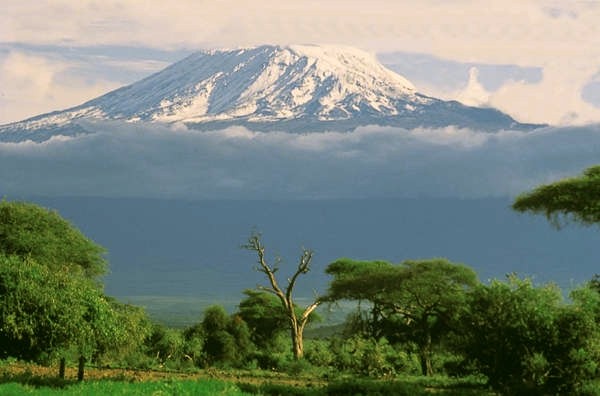
In September, I will climb Mount Kilimanjaro. It's about 19,340 feet, so I kinda have my work cut out for me.

Yes, I will climb to the top of this. Don't laugh.

A reasonable person might be inclined to ask such questions as "why are you doing this?" and "are you a masochist?" or "when did you grow such a giant pair of balls?"

I don't really have a good reason other than "just because." I get bored easily, so I just think this will be a good way to fill my time. It's not really any different than if I took up solitaire or knitting.

Also, I'm not really a masochist, I'm just naive. The operator and head guide that will lead our little trek said the final push to the summit was the hardest, most painful eight hours of his life. His wife said the same, and yes, she's given birth. But they're not invincible like I am. They're at least seven years older.

And as far as growing giant balls goes, who are you kidding? It's me we're talking about here. If I actually knew what I was getting myself into, I'd be signing up for that free knitting class at Joann Fabrics instead of a six day climb to the roof of Africa.

Tuesday, February 06, 2007

Meanwhile in Champaign

I've been home a little more than six weeks now, but it feels much longer. I still think about Leuven every day. I miss it. Terribly.


Ladeuzeplein, mid-morning, Autumn.

Alexander Pope told us long ago in An Essay on Criticism that "A little Learning is a dang'rous Thing." Some people think this drives at the same idea behind "blissful ignorance". They might have an argument, too. While it's foolish to envy the ignorant, life might be a bit easier, on occasion, if everything was a bit more simple. If I never spent time abroad, I'd be more content back in America's Heartland. I wouldn't ache for last October, and I wouldn't daydream of morning bike rides through Haverlee.

The 'castle' at Haverlee. Though it's in the wrong country, it recalls my image of Austen's Pemberley.

Of course, anyone who argues the virtues of a sheltered life is an idiot in my book. Besides, Pope wasn't advocating a simple existence at all. Most people don't bother to go back and read what actually follows his famous line, but if they were to remove their heads from their asses, they'd discover something completely different. Pope was merely observing the naivete of youth and the ability of experience to dampen inspiration. He notes "In fearless Youth we tempt the Heights of Arts," while those who've already bought the tee shirt "tremble to survey/The growing Labours of the lengthen'd Way." If anything, Pope was telling us to embrace the irrational exuberance of unjaded youth and do crazy shit before we grow old and tired.

Anyway, do I miss Leuven so much? Yes. Would my current situation be easier to handle had I never gone? Probably. But I guess that's just the price I pay, and I'd pay it a million times over before I gave it all up. Besides, I have like 1,500 pictures to look through when I get bored.

Haverlee.

Tuesday, December 26, 2006

Taking Stock: My Semester Abroad

I spent one semester, one autumn, and one hundred twenty-one days in Europe during which I completed six courses for thirteen hours of credit.

When I moved in to my twenty-four square meter studio, I bought one fork, one spoon, one knife, one bowl, and one mug. I “requisitioned” several more from the trash.

During my stay, I visited twenty-five cities in eleven countries, accumulated thirty-eight postcards, and sent none of them.

In addition, I personally snapped one thousand, five hundred twenty pictures. At least half of them are garbage.

To get around, I took seventeen flights covering sixteen thousand, one hundred twenty-seven miles, none of which qualified for my frequent flyer program.

I also boarded over sixty different trains going to various cities, airports, and bus stations, only five of which were of the high-speed sort, and I missed five others.

Between planes and trains, I rode eighteen buses.

Border control stamped my passport fifteen times; all but four stamps are boring, EU rectangles.

I read only three books, and I never got a hair cut.

In lieu of reading, I watched four movies one time each, listened to twenty-six episodes of PTI, downloaded five weekly airings of CPR’s This American Life from iTunes, and posted sixty-nine blog entries.

I had a lot of free time.

My mom sent, and I duly consumed, two jars of peanut butter, one jar of jelly, five boxes of Kraft Macaroni and Cheese (The Cheesiest), one box of Club crackers, one tube of original Pringles, and two bags of Pepperidge Farm Goldfish (Cheddar).

My diet was supplemented by over seventy waffles and a sampling of roughly sixty different types of beer shared with students from twenty-two different countries on four continents.

I drank two bottles of Hungarian wine I bought for friends back home. Sorry.

But I worked out a little, too. In twenty-nine short-sided soccer games, I scored one goal.

A total of five people came to visit me on two occasions over two different weeks. I spent one fantastic week with my parents.

At the end of my stay, I waited through two canceled flights and booked eight separate reservations on three different airlines before I could find a flight home for the holidays.

I cannot count the memories.

Thursday, December 07, 2006

It's Beginning to Look a Lot Like Christmas


As I mentioned earlier, I recently spent one last evening in Brussels. They're hardcore about their decorations here. It's way more festive than cities back in the States. In addition to the requisite tree in the Grand Place, the city also set up a nativity scene replete with live sheep. It's weird to see such blatant endorsement of Christianity in public displays. That kind of thing would never happen in Chicago. I'm a bit ambivalent toward nativity scenes myself, but it was still kinda cool. They also had several streets blocked off for a Christmas market and all the other standard accoutrements of the holiday season: Salvation Army musicians with red buckets, wreaths on lamp posts, hot chocolate, etc.

The best part came after dark with a music and light show in the Grand Place. Several multi-colored spot lights were choreographed together with ambient remixes of traditional Christmas songs. With the Hotel de Ville and the other gilded buildings as a backdrop, the effect was awesome. It was the best light show I can remember. Later in the night, a Belgian singer held a concert on the square and sang a bunch of Christmas carols. Given how much fun I had, I might go back just one last time before I leave.


Monday, November 27, 2006

Stockholm Archipelago

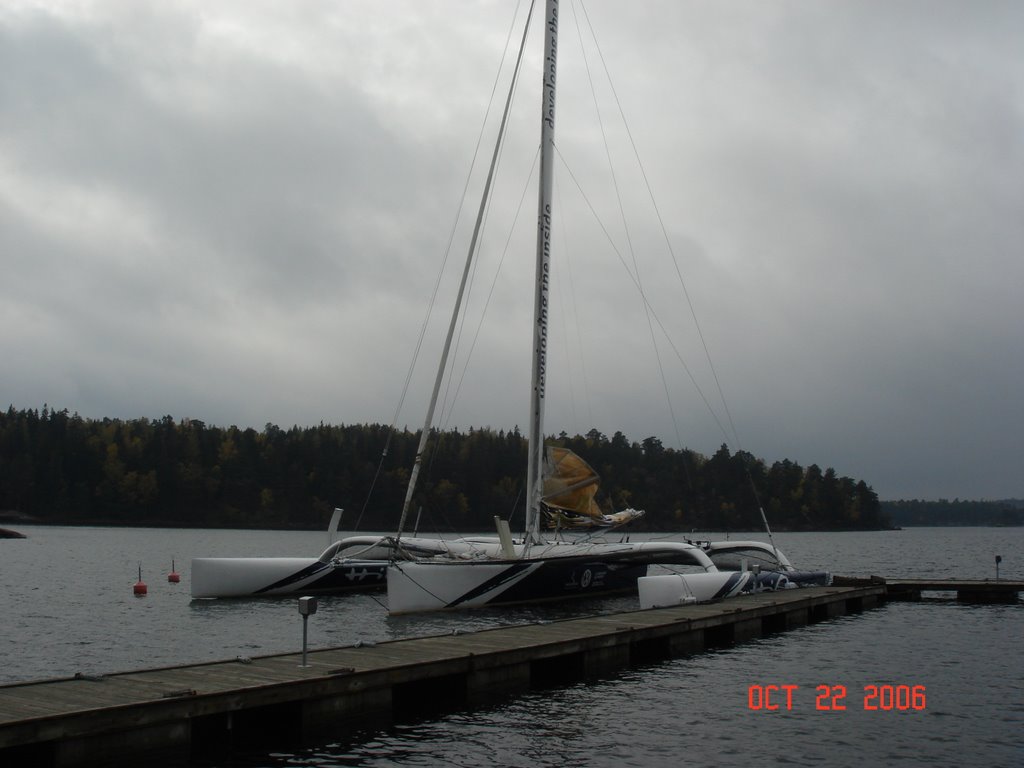
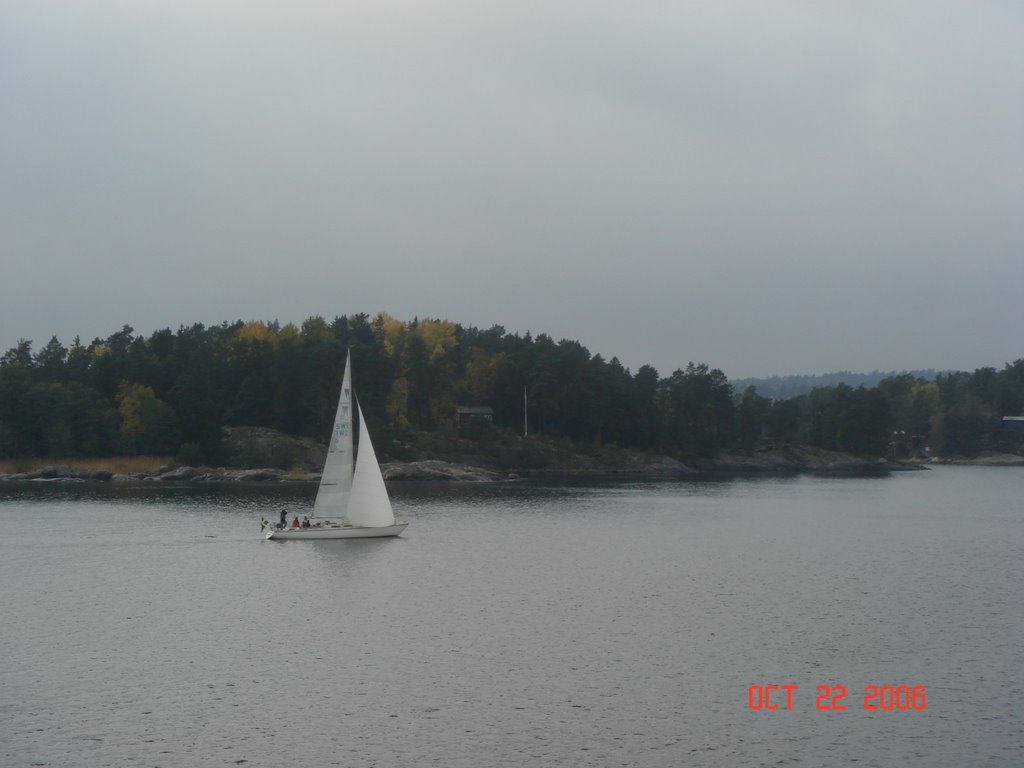
Before I talk about the islands we visited, I have to mention the coolest thing I saw the entire trip. You have to understand, I’ve long had a fetish for trimarans, especially of the racing sort. Given Stockholm’s location on the Baltic Sea, you can imagine the number and variety of boats on the water. While cruising out of the harbor one morning, we came across one such trimaran. Later, we found it docked at the same island we visited. Check it out.

Pure Menace.


Sweetest. Boat. Ever. One day, I'll own one, and I'm not even joking.

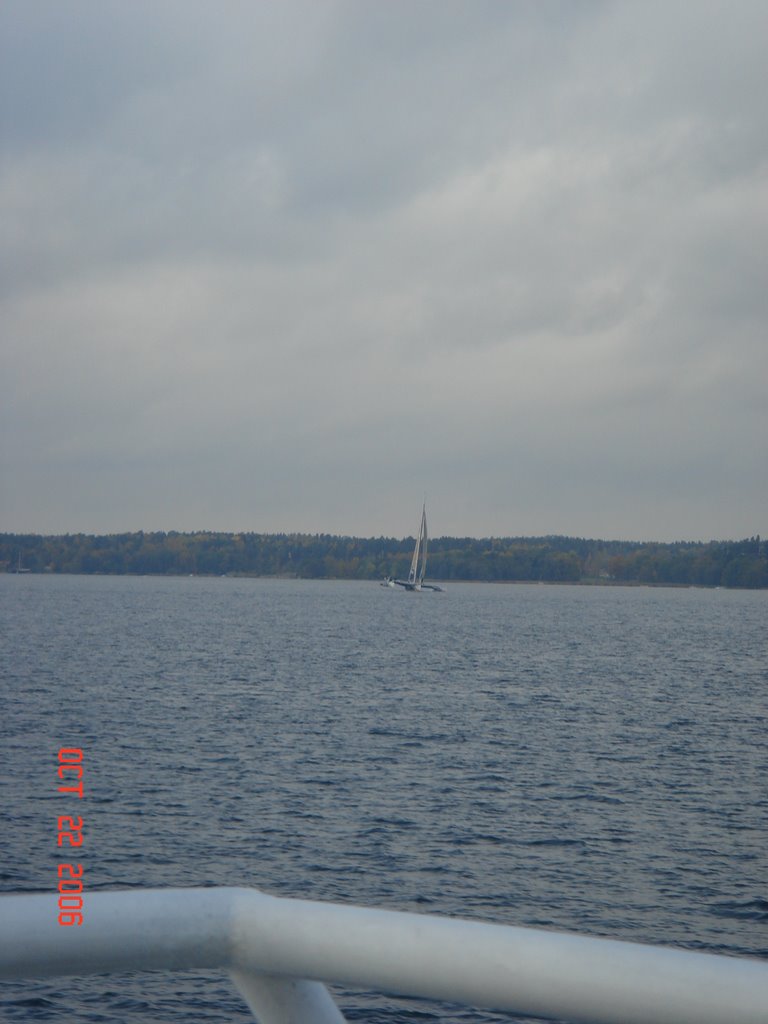
On the way back from the island, we saw it sailing again. In the picture below, you can see it listing to one side. Moments before I snapped the photo, the boat turned and in doing so tilted at least 35 degrees. One of the coolest things ever. The boat was also, by far, the fastest thing on the water. Bear in mind it was moving under sail while everything else in the harbor was under full throttle. I can’t express how impressive I find really fast sailboats and how much I love to watch them.


One last boat note. We came across this military ship thingie during another trip. I didn’t see it until it was almost on top of us. Who knew camouflage actually worked so well?


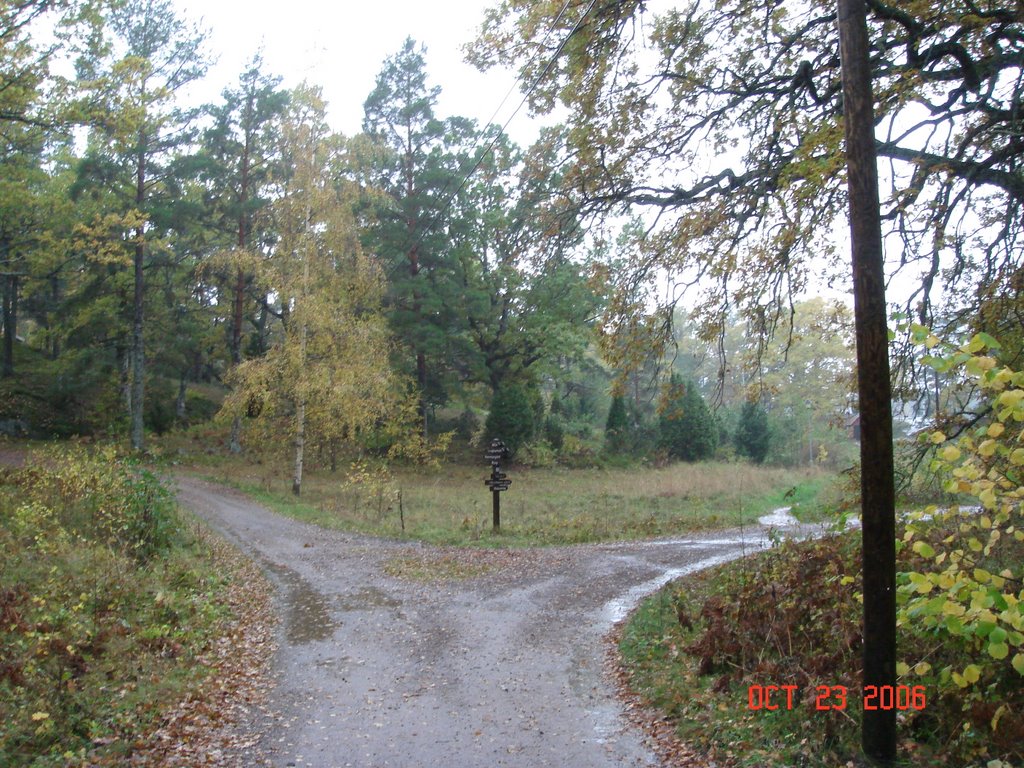
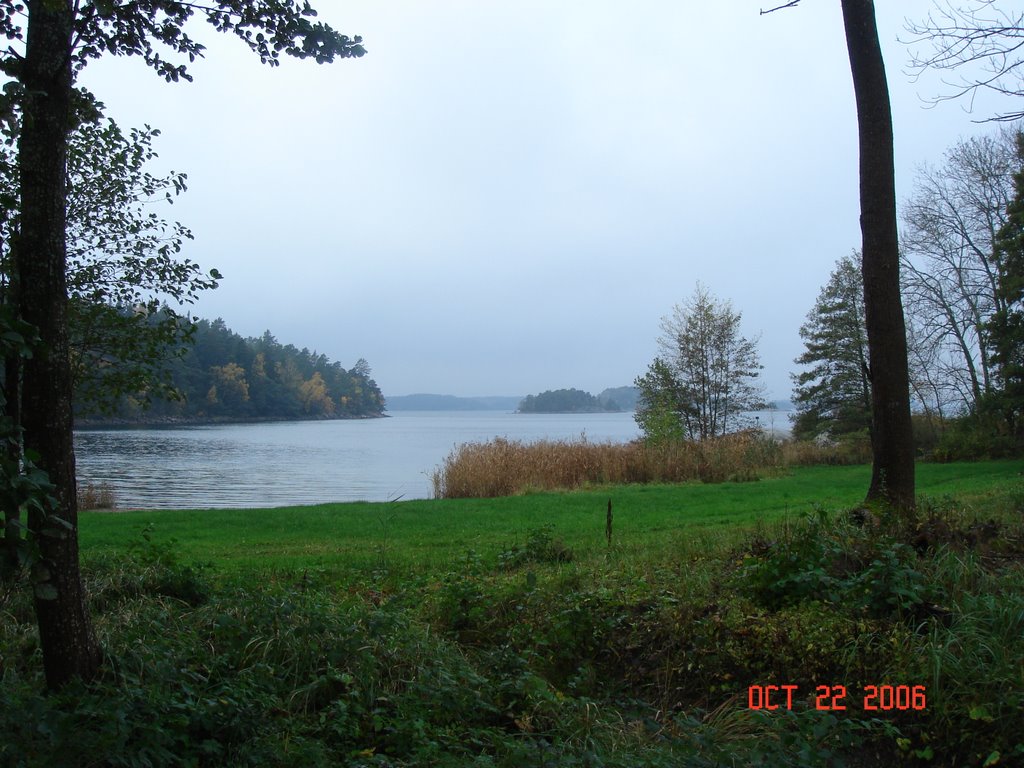
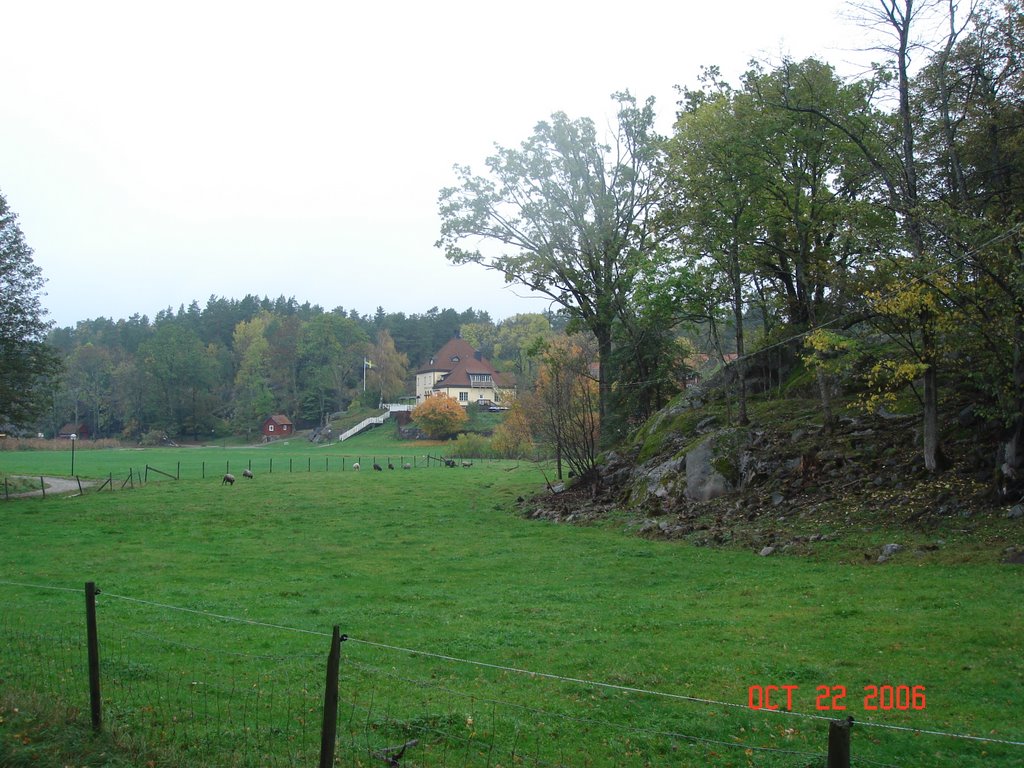
Ok, enough of boats. The first islands in the archipelago we visited were Vaxholm and Grinda. Vaxholm, which supports a small community, notwithstanding, the islands are mostly uninhabited and serve primarily as camping and hiking sites. During the summer, they’d be a great place to visit. In October, however, when it’s cold and wet, the situation gets a bit more complicated. On the upside, however, is that the leaves were changing. All things considered, the first day of hiking was very pleasant. The clouds even broke briefly for about twenty minutes.

Grinda.


Robert Frost, eat your heart out.

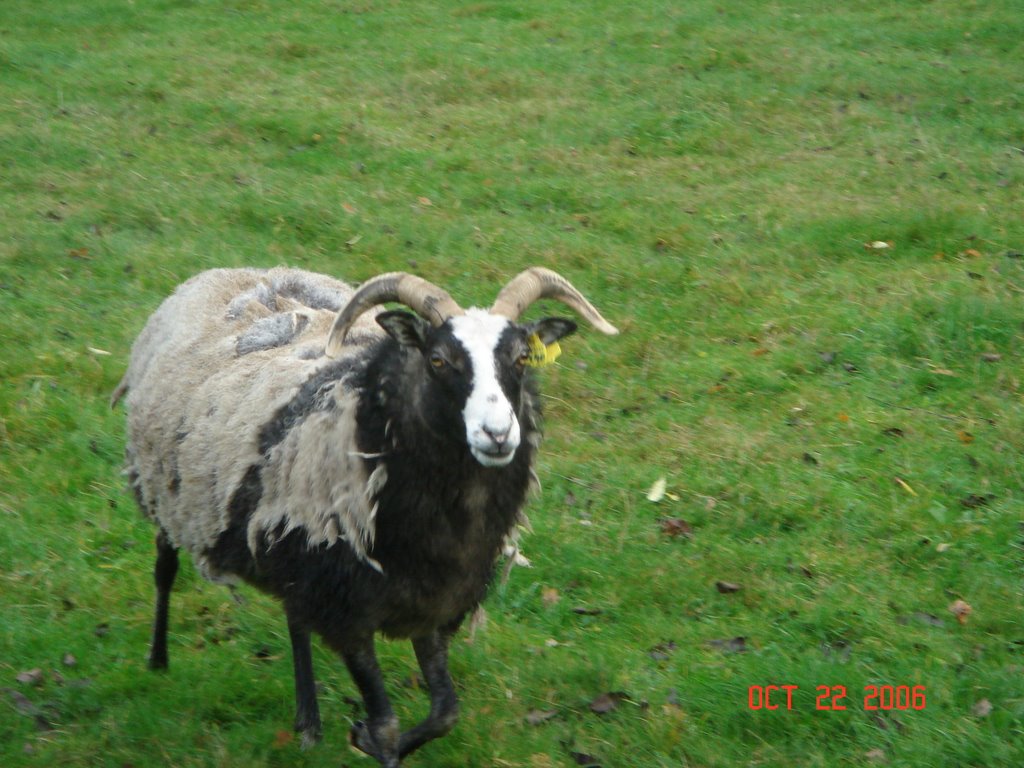
Given that the island only has a few permanent residents, I was convinced something foul was afoot. During our hike, I found evidence. The Swedish government, or perhaps some rogue organization of international bandits, is clearly performing sick and twisted genetic experiments on animals. If you don’t believe me, I present the hybrid goat, ram, sheep, thing below:

I didn’t find any lasers coming out their eyes, but you never know. Watch out.

More pics from the Grinda...


The sum total of civilization on Grinda was a small lodge (or evil lair?).


Our second excursion was a bit less successful than our first. While Vaxholm and Grinda took a little over an hour to reach by boat, Finnhamn, our destination the second day, took three hours. Still, all would have been okay but for the unrelenting, torrential rains. When we finally arrived at the island, we actually found a small hostel not too far inland. Hoping they might have a place to grab some food and warm up (it was only about 40 degrees), we stopped in. Luckily, someone was there, but they had nothing to eat. Instead, she directed us to a small store about a five kilometers from the hostel that sold vegetables and vinegars from a local farmer. Giver her description, we thought it sounded promising, so we headed out in the pouring rain. Below is what we found:


Now, don’t get me wrong. It was a cool, little place. There was no attendant, so you just took what you wanted and left your money on the table. And the vegetables were HUGE. Trouble was, we took a six-hour round-trip boat ride to a nearly uninhabited island in the middle of the Baltic Sea, and then hiked 10 kilometers round-trip through pouring rain, standing water, and thick mud, and this was our reward. I was a little bitter. Nonetheless, I’ll always remember it. Good or bad, it was an unforgettable experience. And that, I suppose, is the point of traveling.

Where.I.Am

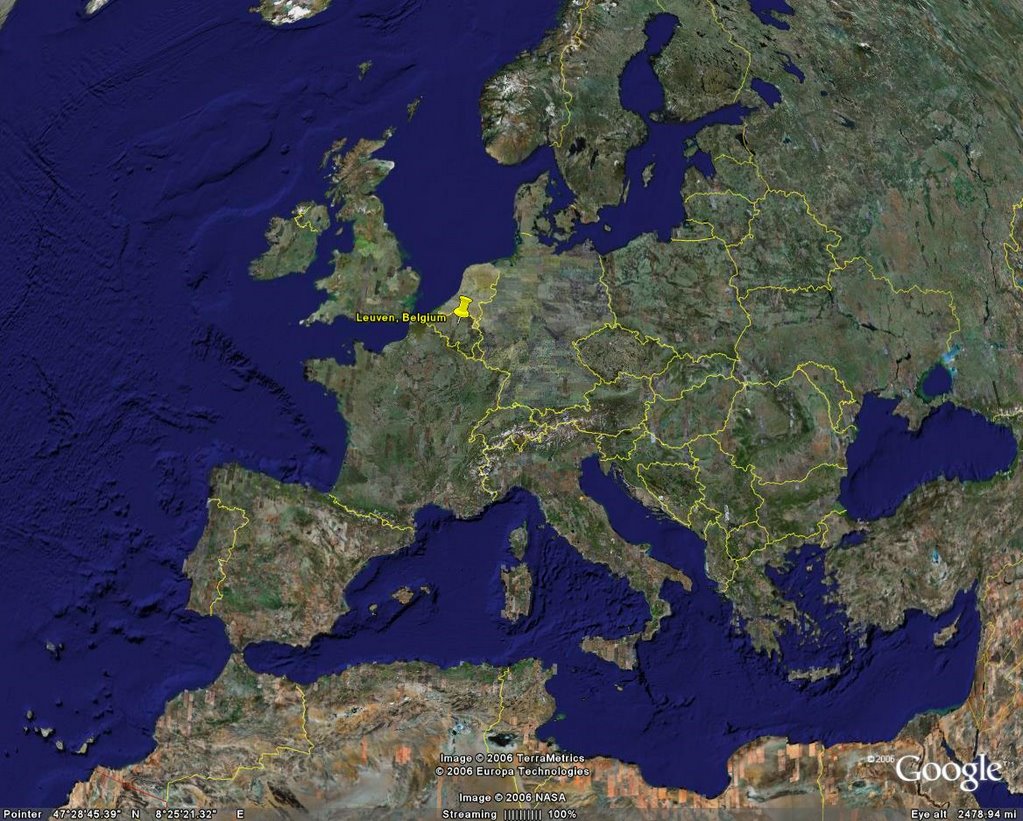
I was messing around with Google Earth, and I thought I'd pinpoint my precise location for all my geographically challenged readers out there. I'm the little, yellow push pin. If you can't really see it, click on the image for a larger map. I'm not sure why, but looking up places on this thing gets addictive.

Stockholm City

It’s been so long I had to check my calendar. Stockholm came and went for me a little more than a month ago. This post is a long time comin’.

The weather, much like the new layout and writing quality of this blog, was shit. With more or less constant rain, it and I were cold the entire time. But I was also, after all, in Stockholm. Life could have been worse.

A quick rundown of the essential: Stockholm is built on 14 islands, most of which sit in the Baltic Sea. Extending further out from the coast is the Stockholm archipelago, a series of over 24,000 islands (more on these in the next post). Though we stayed on Norrmalm, the modern center, the city was first built on the historic Old Town of Gamla Stan. We also spent time on Djurgarden, home to several museums and parks, and Sodermalm, the city’s funky, bohemian area.

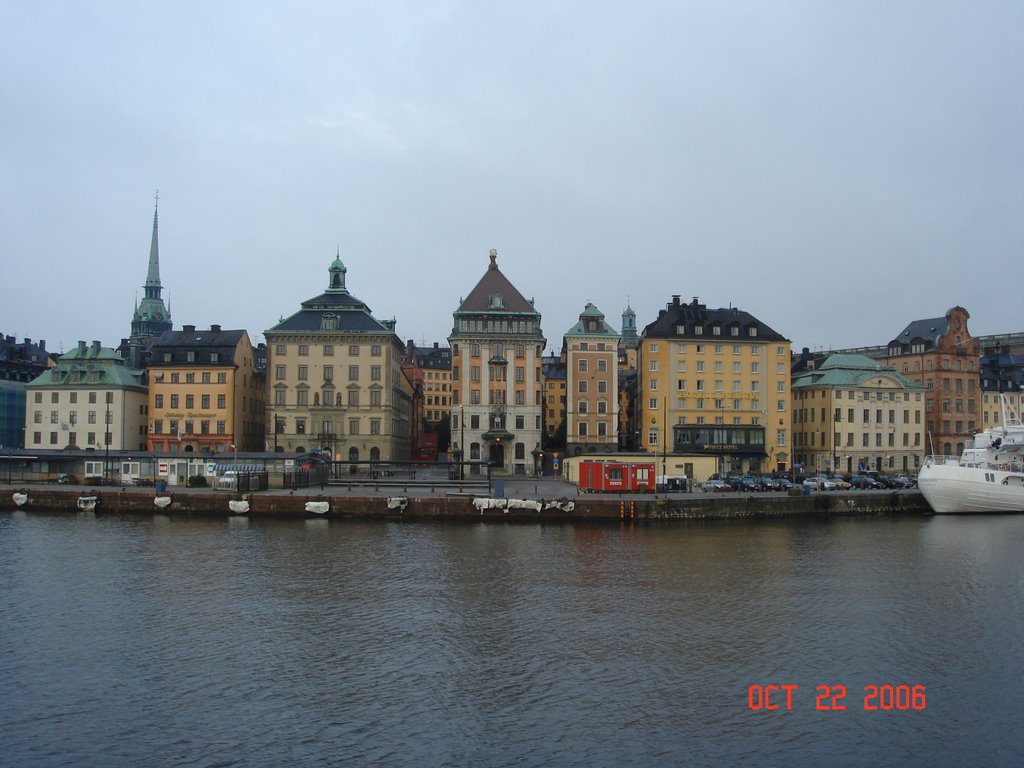
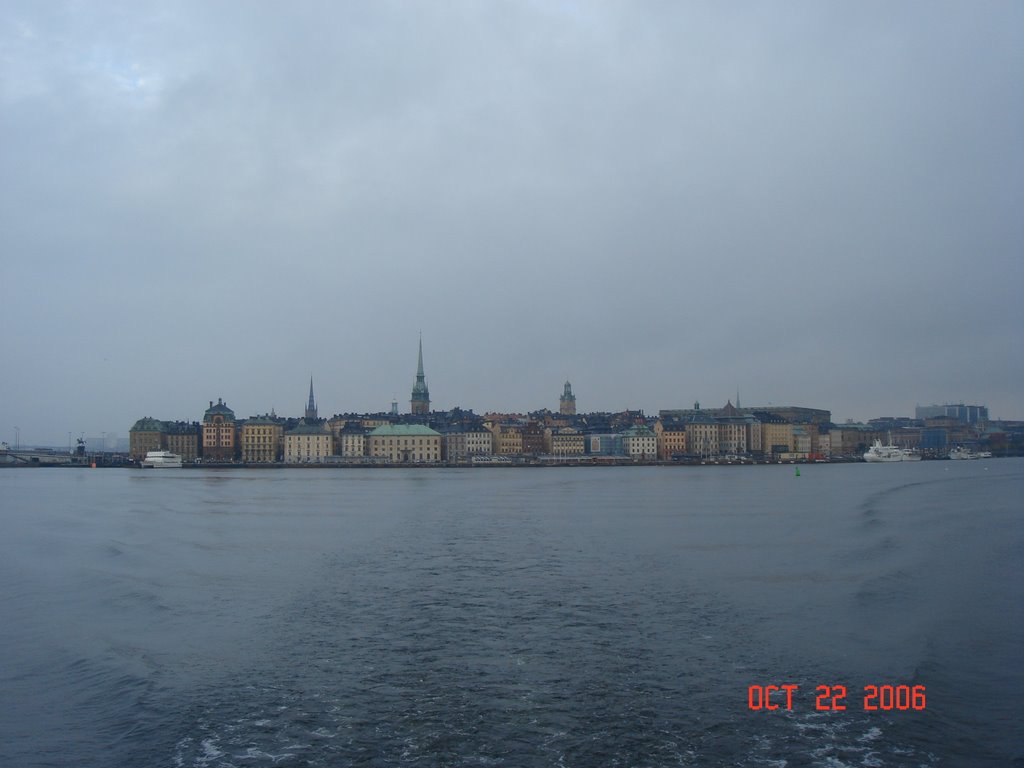
As usual, I spent the first day walking the city. We also took a combination bus and boat tour through the main areas, and I must say Stockholm would be among the most picturesque cities I’ve yet seen (perhaps second only to Edinburgh) but for the low, dark, and omnipresent clouds. Even so, a few of my photos hint at what awaits those who visit during sunnier days.


Gamla Stan up close. Love the architecture.


The whole of Gamla Stan from our boat as we left the harbor.

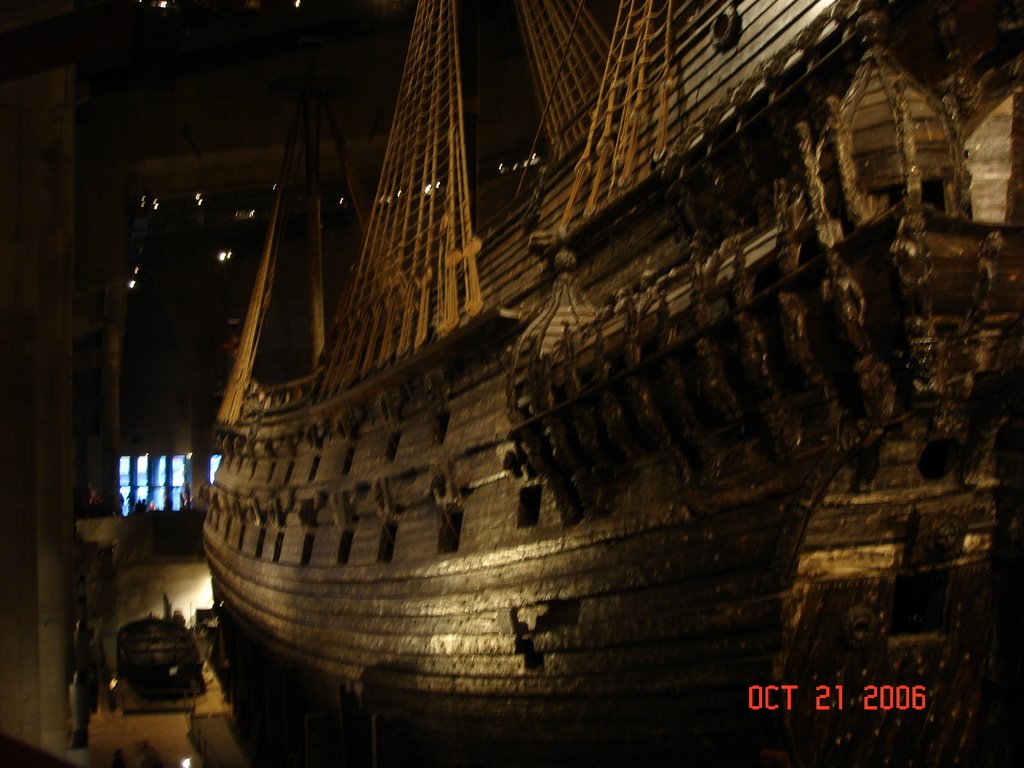
The second day brought more rain, so we headed for cover inside Stockholm’s Vasa Museum. The Vasa is an old Man-of-War that at one time was the largest ship in Sweden’s navy. Unfortunately, it sank on its maiden voyage a bunch of years ago in 1628. Despite the best efforts of our patriotic tour guide to explain otherwise, it basically sank because it was a shitty design. The King personally ordered that a second row of canons be placed above the first, thus throwing off its proportions and causing it to be way too tall and narrow for its own good.

Just how unstable was it? Before each ship was put out to sea, the crew did a stability test which consisted of thirty men standing on one side of the ship and then running to the other. This was repeated several times. The purpose was to get the boat rocking side-to-side and make sure it wouldn’t tip over. When this test was performed on the Vasa, the commanding officer had to stop the men after they made only three runs across the ship because a fourth would have caused it to tip. And yet, because the King really wanted his precious two-gun-deck ship, they sent it off. It didn’t even get out of the harbor before a stiff wind broadsided the vessel, tipped it to one side, and sent it to the deep blue depths below.

Anyway, the Vasa sank in really cold water, which prevented most of the rot and decay. It was recently raised, restored, and put on display. If it sounds boring, you’re wrong. I thought it would be, too, but somehow we ended up spending like four hours in the museum. It was super cool. Unfortunately, to preserve the wood it was also very dark inside, so the pictures are difficult to see.


This is a mock-up of the Vasa. The actual ship stands in the background.


The Vasa, standing at the back and looking toward the front.

Our last day was spent back on Gamla Stan at the Nobel Museum. It's very new, opened only a few years ago, and it’s also very small. Nonetheless, there are few museum experiences I’ve enjoyed more. As someone who plans on winning a Peace Prize one day, I was a huge fan.


Nobel Museum. Look for my picture in here in about forty years.

Before we left, I meandered around Gamla Stan a bit more. A few minutes of people-watching and it’s clear that the legend of a nation full of tall, blonde, blue-eyed, gorgeous women is absolutely true. The other thing I noticed was a bit less exciting. In addition to the ubiquitous McDonalds, Pizza Huts, T.G.I. Fridays, and Burger Kings that infest most every city, Stockholm has a ton of 7-Elevens. Go figure. The irony here is that the aforementioned beautiful blonde behind the counter speaks better English than any 7-Eleven attendant you’ll find back in the States.


Narrow street on Gamla Stan with another 7-Eleven.

A few other randoms...


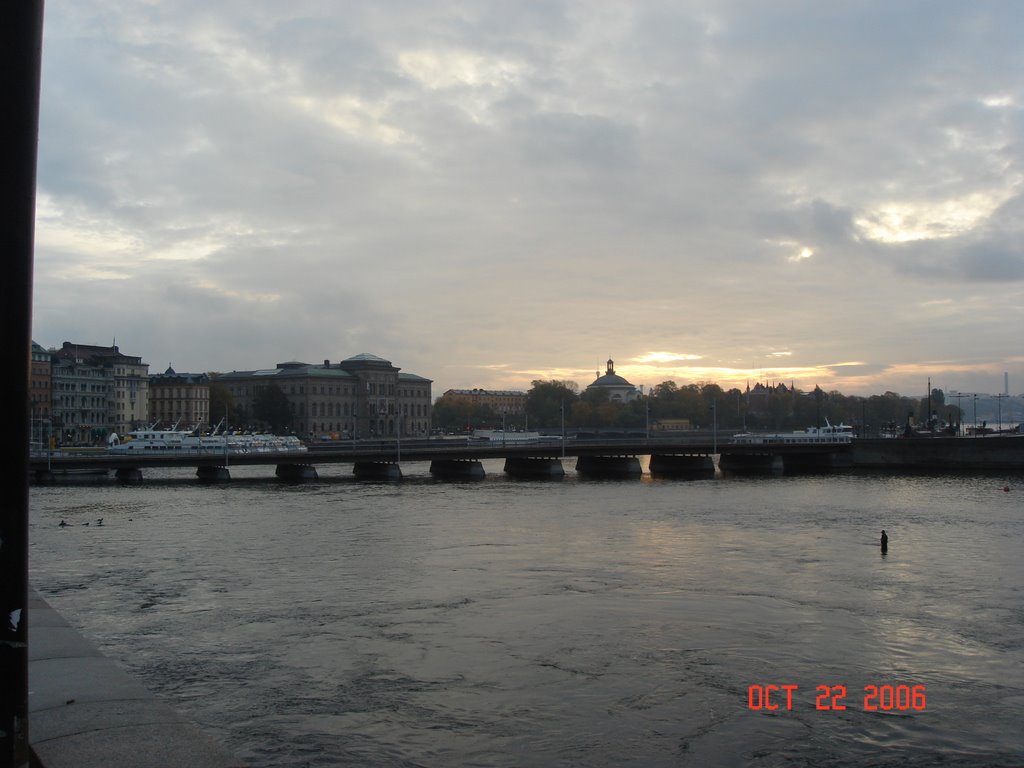
Sunset over Norrmalm.


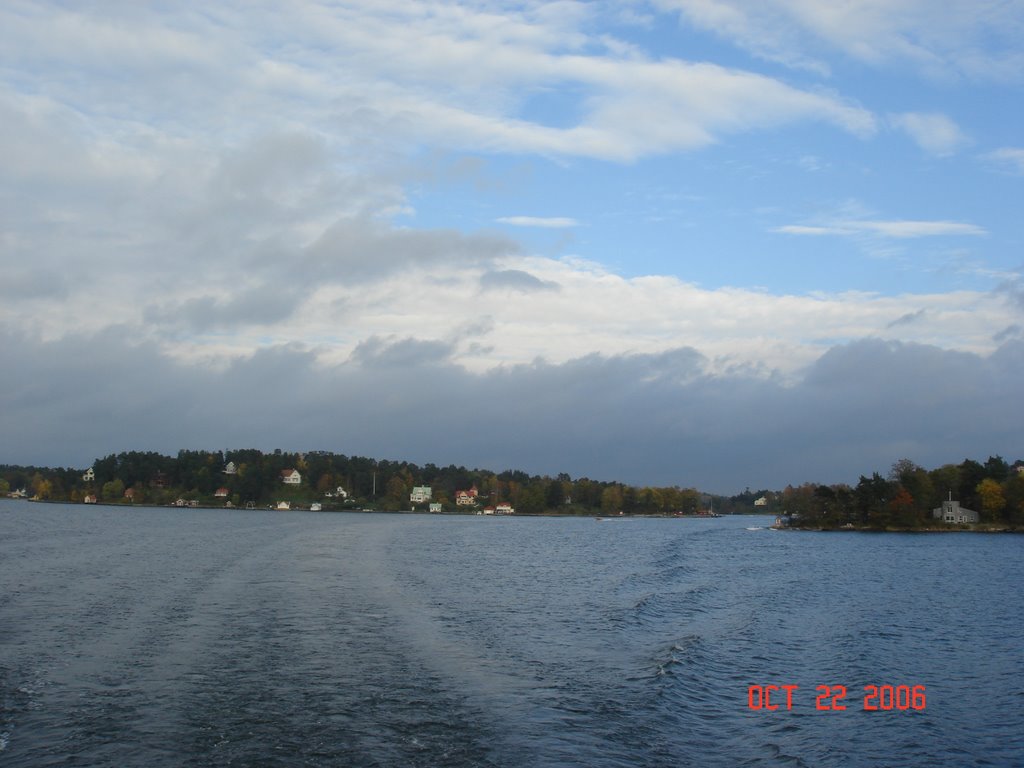
A rare peak at blue skies over the water.


In case you missed my ugly mug, here's me freezing on a boat in the archipelago.

Tuesday, November 07, 2006

Krakow

How do you keep a Polak in suspense?

Krakow came and went awhile ago, but I’m only posting on it now. It was my first foray into a former Communist state. I imagined a heavy atmosphere still dripping with the effects of the now-thawed Cold War (smelted iron curtain?). In some ways, I was right – they’re still working on this whole “capitalism” thing – but in other ways I was pleasantly surprised.

After arriving on a Friday afternoon, we went out that night in Kazimierz, an ethnically Jewish quarter near the main Old Town center. The “night life” there, or its equivalent, was A LOT different from anything I’d seen before. Most every bar was a quiet, dim, candle-lit enclave. Everyone sat close in hushed conversation while classical or traditional Jewish music played overhead. There were probably 15 bars like this in the center of the neighborhood. It was kinda cool, actually, and maybe if I was there with a girlfriend it would have been great. As it was, I wasn’t, so it wasn’t the most exciting night of my trip. But it was also low-key and laid back and provided a nice closure to a travel day.

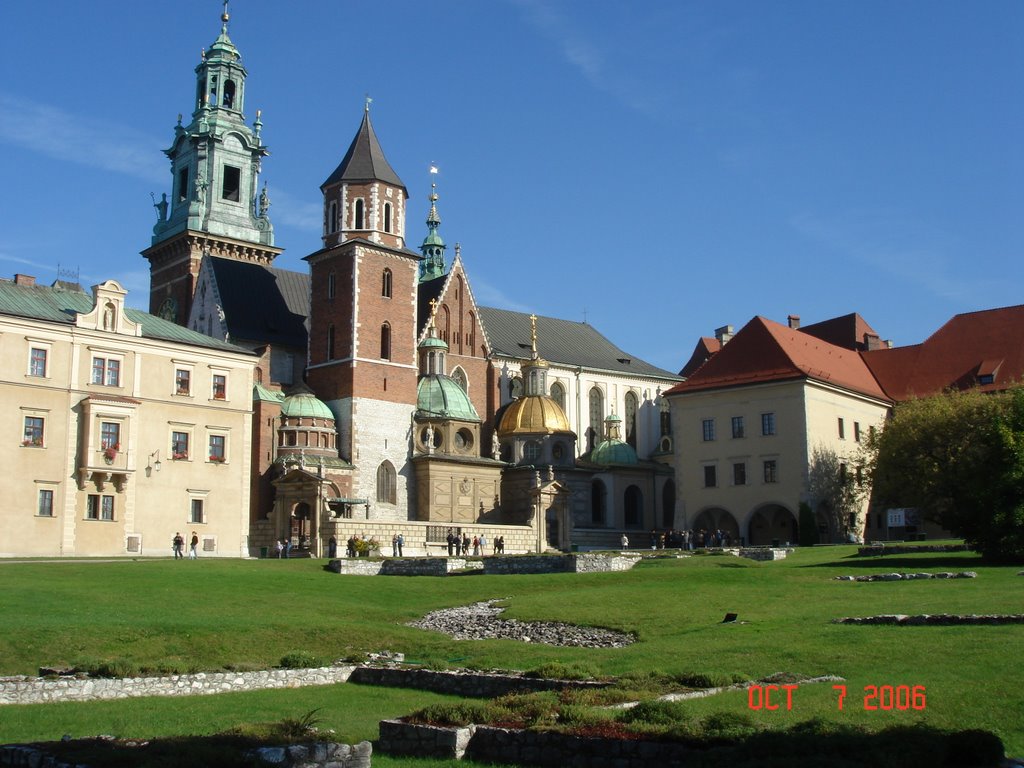
Saturday morning came, and our first stop was Wawel (pronounced “Vavel”) Castle. At this point, the layout of all these European cities should be clear – big castle somewhere near a big center square, usually with an old church somewhere nearby. Krakow is no different. The castle is impressive. Inside, there are ruins of older buildings at the foot of a massive cathedral and state rooms.


Wawel Castle

Inside Wawel Castle - ruins in the foreground, cathedral in the center

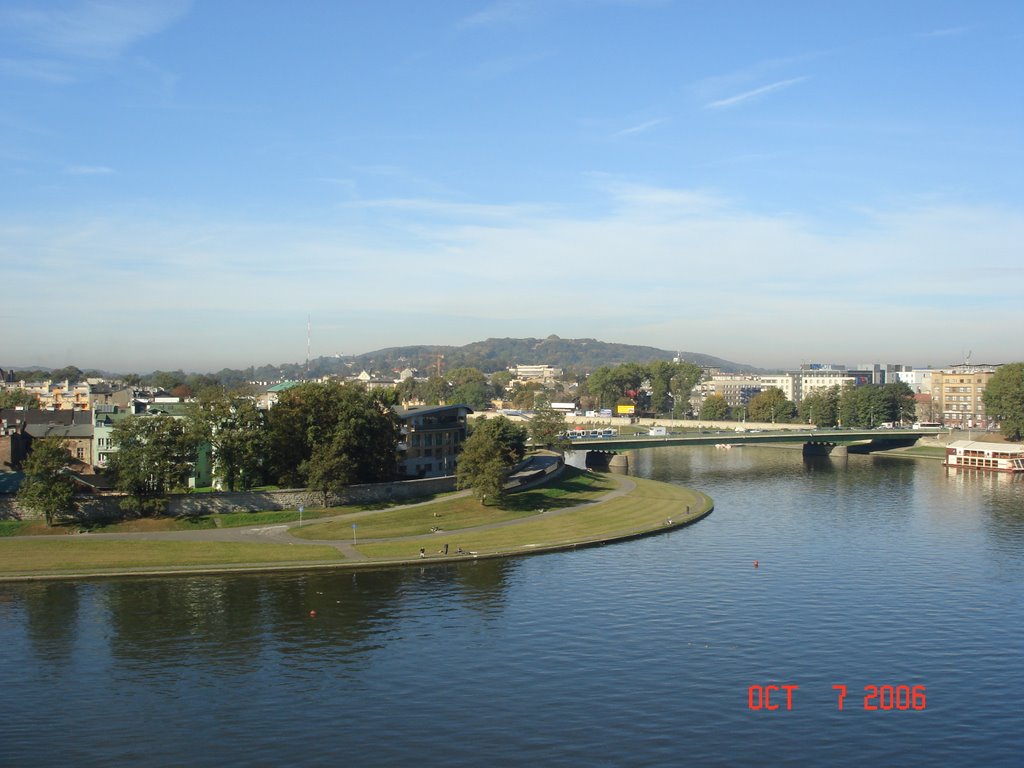
View of Krakow from Wawel Castle

For the hell of it, we strolled through the state rooms which are only about as interesting as they sound. Poland was once a super rich nation in Europe (who knew?), and at the time they built and fitted these apartments with all the finest meats and cheeses in ALL the land furniture and whatnot. Everything’s Italian, which is ironic I think, but ultimately not that interesting.

On to the main square and, shockingly, the requisite old church. The center is actually dominated by an old cloth hall which has now been converted to a large market for all things amber. Krakow (and the Baltic region generally) is the main source of amber in the world, and you can find all sorts of jewelry and other crap made from it. Personally, I don’t much care for it (tacky), so if you were hoping I bought you something, too bad.

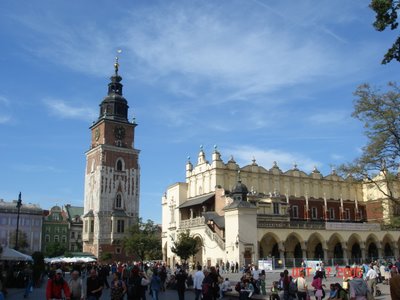
Old cloth hall on the right, clock tower on the left

Next to the cloth hall is the clock tower you see on the left in the photo above. The 70 meter tall Town Hall Tower was originally constructed in the late 13th century. It currently leans 55 cm to one side due to a very strong wind in 1703.

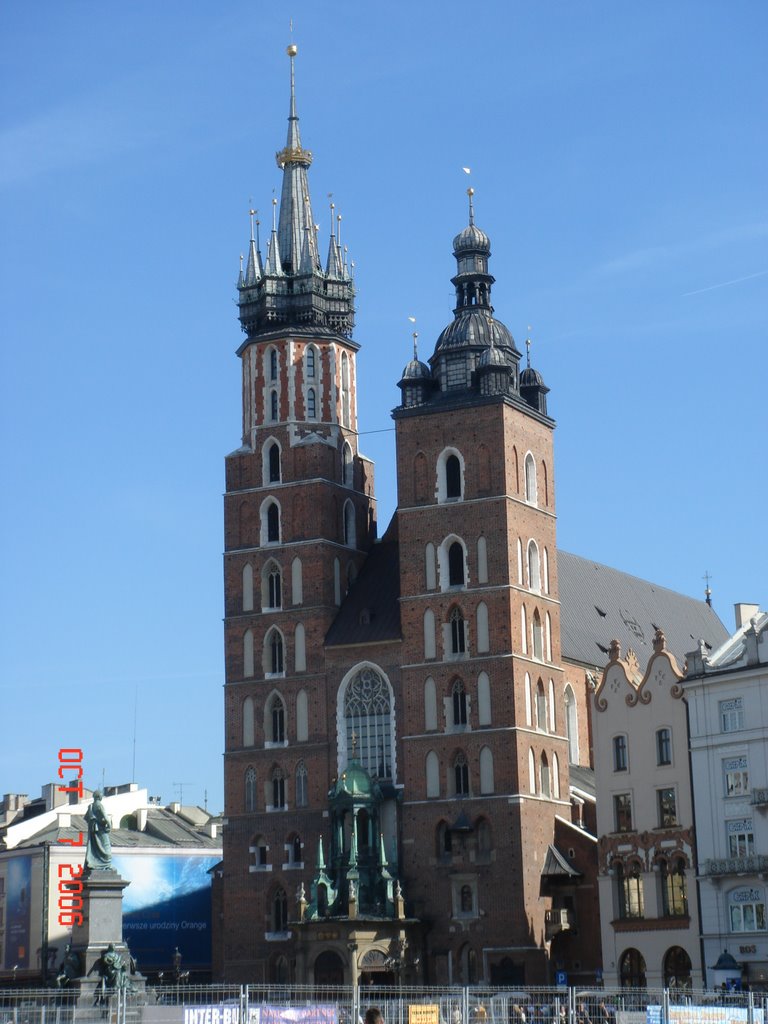
For its part, the unremarkable exterior of the aforementioned old church (St. Mary’s Basilica, below) belies its ornate interior. This is not, however, Pope John Paul II’s old stomping grounds. We unfortunately didn’t make there. The Basilica is Poland’s most famous church and has been around for 1.8 million years I think. Every hour on the hour (even in the middle of the night), a trumpeter plays a truncated tune broken off mid-bar in remembrance of his 13th century counterpart who was shot in the throat while sounding an alarm to warn of a Mongol invasion. Rumor has it this guy sits around and watches TV for the other 59 minutes every hour. Great job.

St. Mary’s Basilica

Overall, the Old Town’s main square is both vibrant and beautiful. There are lots of cafes and shops and street performers, including a group of hilarious young break-dancers no older than 12 who plied and perfected their trade to the tune of their buddies’ crazy beat box skills. Awesome.

The second night we were there, we ditched the scene in Kazimierz for something more lively. After pregaming at the hostel bar with a bunch of Aussies, New Zealanders, and Irishmen, we all headed out to the bars. On our way, we came across a tiny, rusted-out, purple, Communist-era “car” that seriously looked almost exactly like the one below parked along the side of the road.

Not the actual car, but damn close to it

The obvious question all popped into our heads at the same time: how many Polaks does it take to lift and carry a Communist-era go-kart? (Trust me - you’d ask the same if you were wandering wasted through the streets of Old Krakow) Well, I can’t say exactly, but I can tell you that it takes three Aussies, an Irishman, and a Lithuanian to lift and rotate the car 90 degrees. Good fun. We all laughed and they went into another bar across the street while some new friends and I stood outside a little longer.

Trouble was, while we were still standing outside, the cops came by and accused us of moving the car. To make a long story short, it took about ten minutes and a clutch knowledge of French by Danielle, one of my new friends, to get us out of the situation. We quickly left the area and headed to a club called Prozac which was way too much fun.

Later that night we learned the cops pulled the other Aussies out of the bar and interrogated them for about twenty minutes outside. Eventually, they fined one guy 200 Zlotys (about $60), which he paid in cash, before letting everyone go. Crazy Aussies. Crazy times in Krakow.

So why do I say they’re still working on the whole “capitalism” thing? There aren’t too many specific instances I can tell you about, but it’s clear that some things are grossly over-priced, and many more things are just the opposite. Also, entrance to many sites such as Wawel Castle is free, despite the fact that a fee-based system would surely be successful given its popularity. In another case, two street vendors stood selling the same pretzels not more than 30 meters apart, yet one guy was charging twice what the other one was. And both were selling out!! Maybe the lower priced guy didn’t like money, or maybe the customers of the higher priced guy were feeling rather charitable that day. I don't even know. There were seriously no differences in product. How this happened is beyond me.

All in all, Krakow was fantastic, and like pretty much every other place I’ve been, I highly recommend it. It’s a great destination for someone looking to ease into Eastern Europe. As one of the “new Pragues”, it’s still very cheap and still has a “charming” touch of Communist influence, but it’s probably a bit more developed than some other places further to the south.

Tuesday, October 17, 2006

Munich Part III – Championship Drinking

Story time.

So remember the Italians I mentioned below? There were about six of them, they were from Florence, and they loved us. When we said we were from Chicago, their immediate response was “Chicago Bulls!! Michael Jordan!!” (this was not the only time, by the way, that Europeans connected Chicago with Michael Jordan). We all chanted “JOR-DAN JOR-DAN” several times until one guys, not a Bulls fan but instead a fanatic of San Antonio, started naming players on the Spurs. He threw out names like Tony Parker and Tim Duncan, and then he came to Robert Horry and the fun began.

For an Italian, this guy knew way too much about the NBA – more than many Americans. In fact, my guess is that most Americans don’t know this, but Robert Horry’s nickname is “Big Shot Bob” for his penchant for hitting, well, big shots at the end of games. Our little Italian friend was apparently a huge fan, and so to counter our Jordan chant, he started up with “BIG SHOT BOB!! BIG SHOT BOB!!”

For the next five minutes, we all joined in. So half way around the world from San Antonio, standing in the middle of a beer tent at Oktoberfest, four Americans and six kids from Florence chanted, in union, “BIG SHOT BOB.” Traveling is great.

The same night, we thought it would be awesome to do chest bumps down the street after Oktoberfest closed (the tents shut down around midnight, and everyone goes to bars or clubs afterward). Tino met one guy from somewhere (not the US, maybe Germany?) who saw the awesomeness of the chest bump and wanted to do one, too. This guy was like 5’10”, 250 – huge – and piss drunk. He had half a beer on the front of his shirt. But when he chest bumped Tino, who is probably half his size, he fell flat on his ass backward. Best chest bump ever. The guy stood up, high-fived Tino, and went back to dancing like nothing ever happened.

Along the lines of messing with Europeans, we also taught a few fellow Oktoberfesters a new English word. As you can imagine, there is a lot of toasting during the Beer Fest. Pretty much every five minutes at least, someone gets the bright idea to have a toast and clank the giant, glass mugs together really hard. Sometimes they break and shatter. Sometimes they slice someone open and they start gushing blood. Championship drinking is a contact sport, after all.

Anyway, “cheers” in German is “prost”. Not many people knew “cheers”, which is good because it’s not that cool. So instead, whenever someone else taught us the equivalent in their language, we taught them to shout “SEXYTIME!” Let me tell you, there are few things funnier than watching two guys from Helsinki shout “sexytime” at the top of their lungs and have no idea what the hell they’re saying. No wonder no one likes Americans.

Oktoberfest is great.

And I’m obviously not the only one that thinks so. Several other friends of mine trekked out to Munich independently of Jeff, Mark, Tino, and me. I really had no expectation of seeing them, and I wasn’t even sure when they’d be there. But despite the other six million people, I managed to run into not one, but two different groups of friends unexpectedly. I saw one friend, George, who is currently studying in Hamburg, at the train station. And I also ran into four girls (and I might add, four of the coolest ones you’ll ever meet) with whom I spent much of my first year of law school studying (they were graduate accounting students studying for the CPA at the same time), and with whom I unfortunately haven’t spoken very often in the past two years. So to Sue, Val, Liz, and Jessica – it was great seeing you guys.

All in all, I honestly haven’t had that much fun in a very long time. We stayed for four nights, and by the end our bodies couldn’t take much more. I’m not sure we could have handled one more night. On Saturday, I returned home to Leuven and the guys caught a flight back to Chicago. I spent the next three days exhausted, sick, fatigued, and generally feeling like shit. Yet, each night all I really wanted to do was head back to a beer tent, stand on a bench, drink German beer, and sing awesome music. Even though I felt like crap, I was definitely rejuvenated in a way only friends can do. We met a couple people that were on their third or fourth visit to Oktoberfest, and I honestly hope that I make my second trip back next year. If you like partying, having fun, and meeting random people from all over the world, I *highly* recommend the experience. Start saving your pennies now for next September – it’s way more than worth it.

Monday, October 16, 2006

Munchen Part II – Beer Fest Primer

Let’s be serious. This was the main reason for the entire Brussels/Amsterdam/Munich trip. I don’t have too much to say, except that it was one of the best times I’ve ever had.


For the uninitiated, a primer: Munich takes pride in their beer as much as Belgium does (if not more so), but they also take pride in how much of it they drink. I think I read somewhere that Bavarian citizens (Bavaria is the region in which Munich is located) average over half a liter of beer per day.

Bavaria is to Germany like Texas is to the US; culture there is entirely different from the rest of the country. When I told a German guy I met in Leuven I was going to Munich, he cringed and made me promise not to judge the entire country by it. People there actually wear lederhosen for the hell of it. I thought it was just a costume thing or something that Germans wore a long time ago. But these people wake up in the morning and think, “hmm, what should I wear today… my brown lederhosen? or perhaps my brown lederhosen? It’s awesome.

So they drink a lot and they dress funny, and Oktoberfest (locally known as “The Beer Fest”) is basically just an excuse to party, drink even more, and still dress funny, but this time for the world to see. And it is a world affair. We met fewer Germans than internationals, including Italians (more on them in a minute), Finns, Swedes, Japanese, and the omnipresent Aussies. Of the six million people that descend upon Munich every September, one million are Australian. To put this in context, Australia is a nation of only 20 million people, so fully one twentieth of the entire continent treks to Munich every year. That would be like the entire state of Illinois going, plus another 3 million. Crazy.

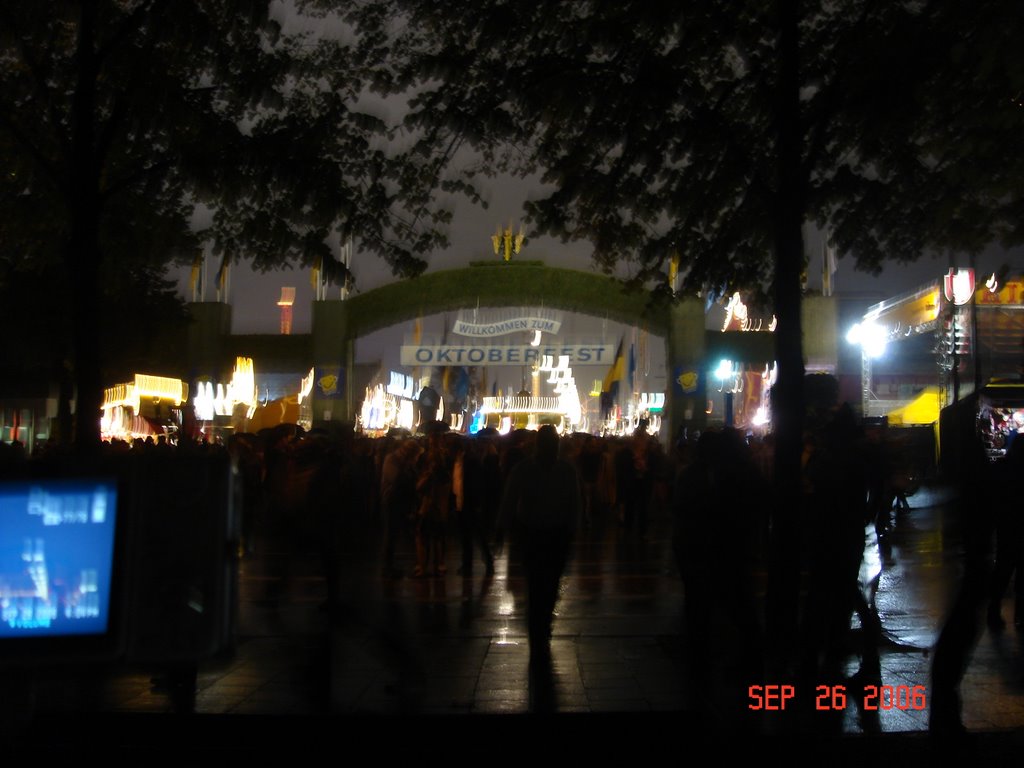
Anyway, so Oktoberfest, at its heart, is a simply a festival, but Barry Bonds style – everything here is bigger than it should be. There are all your staples: rides that spin you around, slides, food stands, places to buy overpriced souvenirs, etc., but the best part is obviously the beer tents.

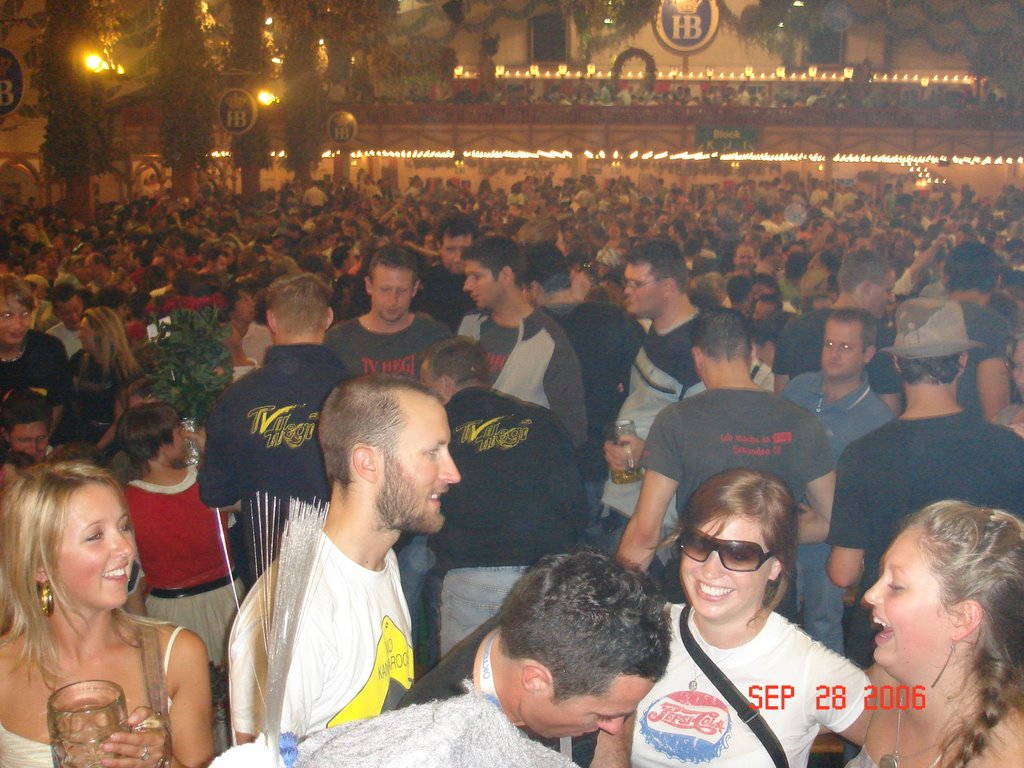
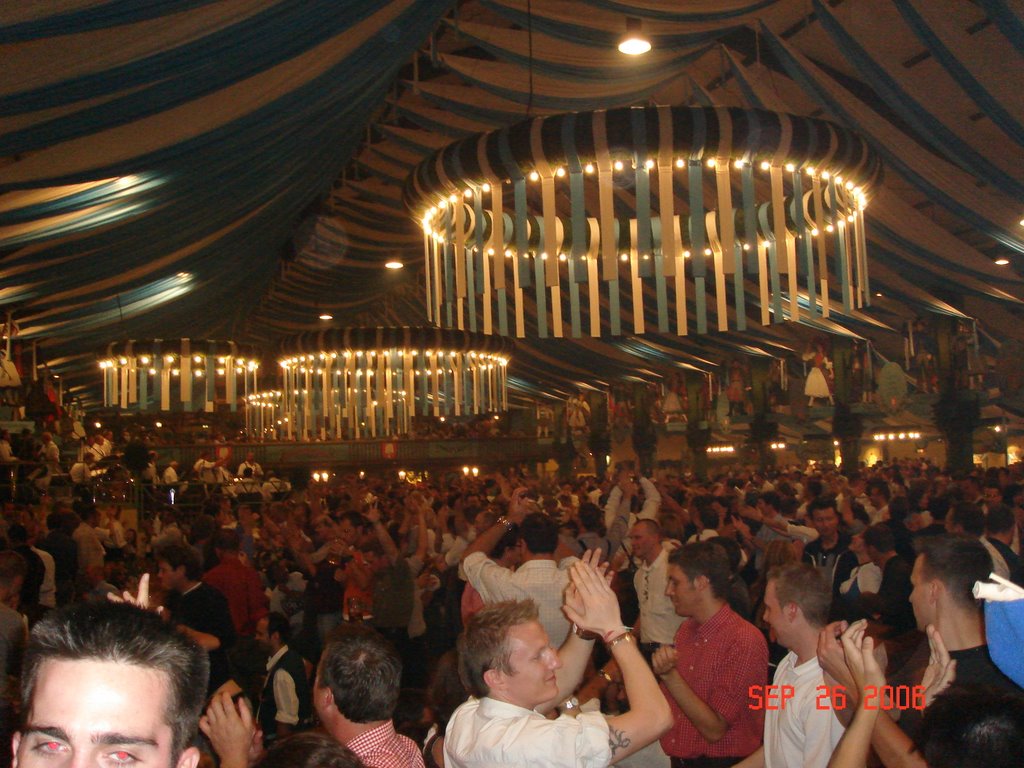
Now, to be clear, these aren’t your typical tents. They’re completely enclosed and heated, and have kitchens and bathrooms and everything else. The biggest, the Hofbrau tent, officially holds 10,000 people, but it gets so packed I’m sure there are even more. The tents are filled with picnic benches, but no one sits down. Everyone stands on the tables. And of course, everyone drinks a ton of beer. For the low, low price of only 8 Euro, they serve up a one liter "mas" (huge ass mug) full of yummy goodness. They’re huge. My arms got a workout just holding those things for four nights.

One of the smaller tents.

Inside the Hofbrau tent.


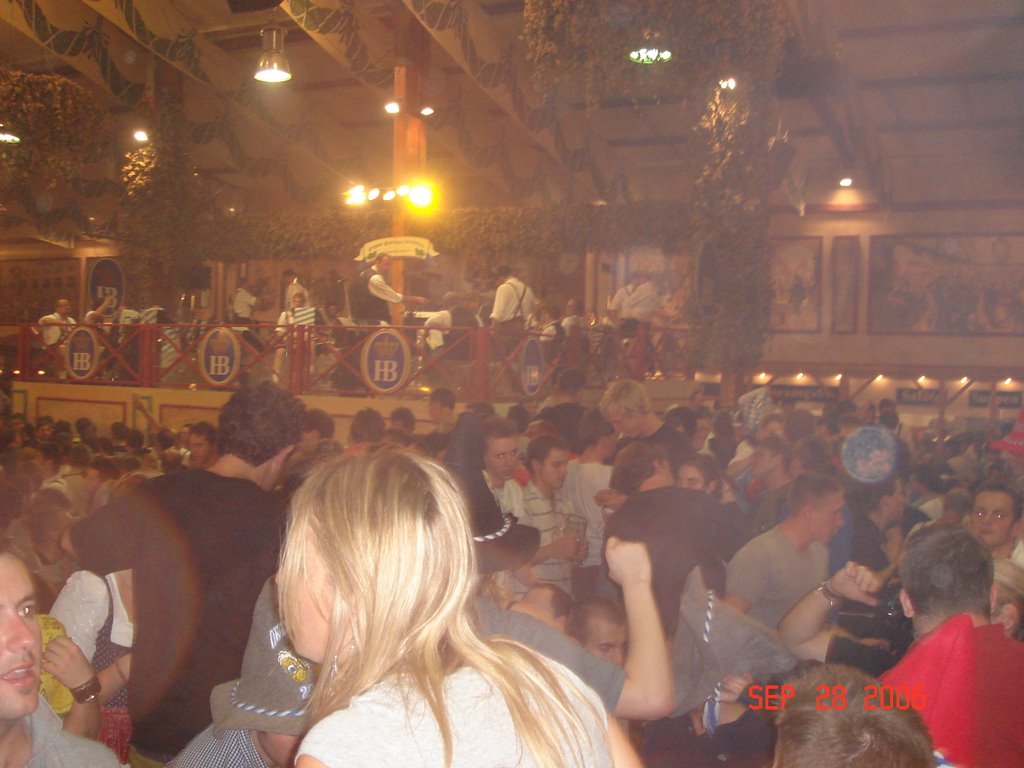
But in case drinking copious amounts of beer and partying with crazy internationals isn’t enough for you, each tent has a traditional Bavarian brass band. And while they play the occasional traditional Bavarian song, they mostly rock out to American music from the 70’s and 80’s. We’re talking Satisfaction, Sweet Home Alabama, Sweet Caroline, Take Me Home, etc. The amazing thing is that the Germans knew more of the lyrics and we did. Everyone sings. Loud. And dances. And falls off benches. And cuts themselves on broken glass. And laughs at people who fall off benches and cut themselves on broken glass. In short, BEST. TIME. EVER.

Band at the Hofbrau tent.

This guy's face says it all. He probably had a beer or two.

Sunday, October 15, 2006

Munchen Part I - The City

I’ll dispense with the non-Oktoberfest related first, because it’s not quite as fun. During the occasional sober moment, we toured the city two or three afternoons. Believe it or not, Munich has more to offer than just one, great Beer Fest. I actually really enjoyed what I saw. It’s perhaps the first city I’ve walked this semester where I felt like perhaps I’d enjoy living there.

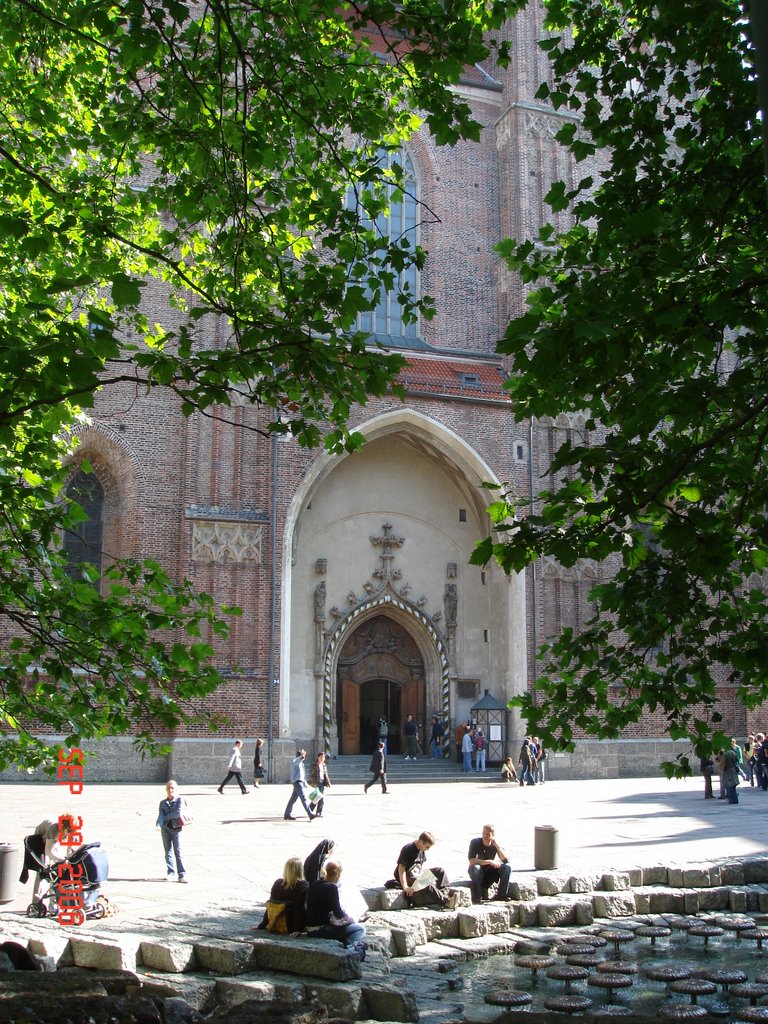
As with every other European city, it has its share of old churches near the city center. I’m a big fan of the one below, Frauenkirche, and it dates to the fifteenth century. Inside can hold about 20,000 people. The square in front, which you see the foreground of the picture, has a cool water fountain and place to hang out.


And also like most other European cities, it has a city center that makes for a tourist trap. In Munich, it's called Marienplatz, and on one side is its famous glockenspiel. At various times throughout the day, the little wooden sculptures at the top dance around and joust. I guess it’s cool, mostly because jousting is awesome.

The glockenspiel is in the central tower inside the corroded-green brass facade. The building in which it resides is the old city hall.

One afternoon, we took a brewery tour around the city and stopped at a few of the major beer houses and breweries. Beer houses are much like beer tents, just more permanent: big open spaces with picnic tables, food, and of course a ton of beer. One of the houses we stopped at was the famous Hofbrauhaus. It’s one of many beer houses owned by the major brewers in Munich, but it’s also both the largest and most notorious. It holds over 3,000 people, and it was here in February of 1920 that Hitler gave one of his first and most important speeches. "The First Hofbrauhaus Speech”, as its known, laid out a 25-point plan that formed the basis for his new party, the National Socialist German Workers Party (or Nazi, for short). Thus, the Nazi party was born right here. On a lighter note, it's freakin' sweet to drink at.


And of course, no city center would be complete without its share of street performers, but I thought this guy was rather inventive. Apparently he’s been around for awhile, because I saw postcards of him in souvenir shops. Somehow he wires himself up with tubes to form something of a fountain, and every once in awhile he sprays people with water. He also made robot noises when he moved, which was awesome.


Street artist on Marienplatz.

Saturday, October 14, 2006

Amsterdam Part III - Tomfoolery

When we arrived in Amsterdam, we picked up the usual smattering of tourist brochures and maps. One advertisement said the city’s biggest problem was public urination, and it warned not to partake in this cultural experience. And since much of the city does indeed smell like urine, we thought it was funny.

Monday night rolled around (our second night in Amsterdam), and we found ourselves in a small bar on the outskirts of the red-light district. This was just a straight-up pub – nothing “red light” about it – and the bartender was freakin’ awesome. I think his name was Rick, but that’s probably wrong so we’ll just pretend. We got there early, stayed ‘til it closed, and rocked out to sweet American music from the 70’s and 80’s the entire time. Lots of beer. Lots of new random “friends”. And even more fist pounds with Rick. Don’t ask.

Anyway, it was a great time, but the bar had to close at some point. I think we were kicked out around 3:00 or 3:30 AM, after which we slowly started to wind our way back to the hotel. That’s when things got interesting.

At one point on the way home, Tino and I turned around to find Jeff and Mark walking down a small alley in the wrong direction. It was a long way home, and we were walking slow, so we just figured they wanted to partake in the aforementioned Amsterdam tradition (after all, when in Rome…). So they’re down the alley peeing, and all of the sudden two guys on bikes (GOBs) go flying past Tino and I down the alley. Jeff and Mark are probably 40 meters away, so we can’t really hear what’s going on, but we see the GOBs surround them so they can’t walk away. We also see a third guy on foot, also not in a uniform, standing near them.

So Jeff and Mark finish their study in Amsterdam culture, and the GOBs herd them into a small, unmarked door – the only door in the entire alley. Now things are getting messed up. Two GOBs, who may or may not be cops, just surrounded our friends and took them into a seedy, unmarked door down a dark alley in the middle of the red-light district of Amsterdam.

Now, at this point I should say Tino and I were pretty confident these were police officers. It’s not like we just let two random thugs kidnap our friends. Another girl we were with thought she saw a uniform on the GOBs, and Jeff and Mark went willing into the door. It’s not like they were alarmed or anything. Nonetheless, we all thought it was pretty shady. So while Tino stood at the top of the street to wait and see if they appeared somewhere else, this other girl and I went down and pounded on the unmarked door. Eventually we were buzzed in and found ourselves in the holding room of the only freaking police station in the entire red-light district! I could hear Jeff and Mark talking on the other side of the door, and eventually some other cop told us they were being fined. About 20 minutes later, the two came out, each 75 euros poorer. oops.

Walking home, we got the whole story and a funny epilogue. Remember the third guy on foot standing around them as they were led into the police station? He was a drug dealer who offered to sell them cocaine while they were peeing. But he didn’t get fined or arrested. He just walked away. So Jeff and Mark pissed in an alley, something so many others do (albeit not on a police station), and got fined 75 euros and berated by the cops at 4 AM while the guy dealing cocaine just walked off looking for more customers. Go figure. Only in Amsterdam…

Anyway, good times.

Monday, October 09, 2006

Amsterdam Part II – Daylight

Amsterdam is a study in dichotomy. Daytime is polarized from the city at night by more than the presence of light. The entire character changes. In day light, Amsterdam is a beautiful city.

With only one full day there, we had to prioritize our activities. There just wasn’t enough time to see everything I would have wanted. Instead, we settled on a visit to the Anne Frank House and museum, followed by a boat tour of the city’s canals in the afternoon. This meant we never made it to the Van Gogh and Rembrandt museums.

The Anne Frank House is very well done. Tourists are granted access to the entire hideout, all of which is preserved incredibly well. For instance, many of the magazine pictures Anne Frank pasted to the walls of her room as decoration are still hanging. I read her diaries a long time ago for school, but walking through each room of the annex quickly refreshed my memory. It’s a great experience, even if it’s not the easiest thing to get through, and it was my favorite part of the city.


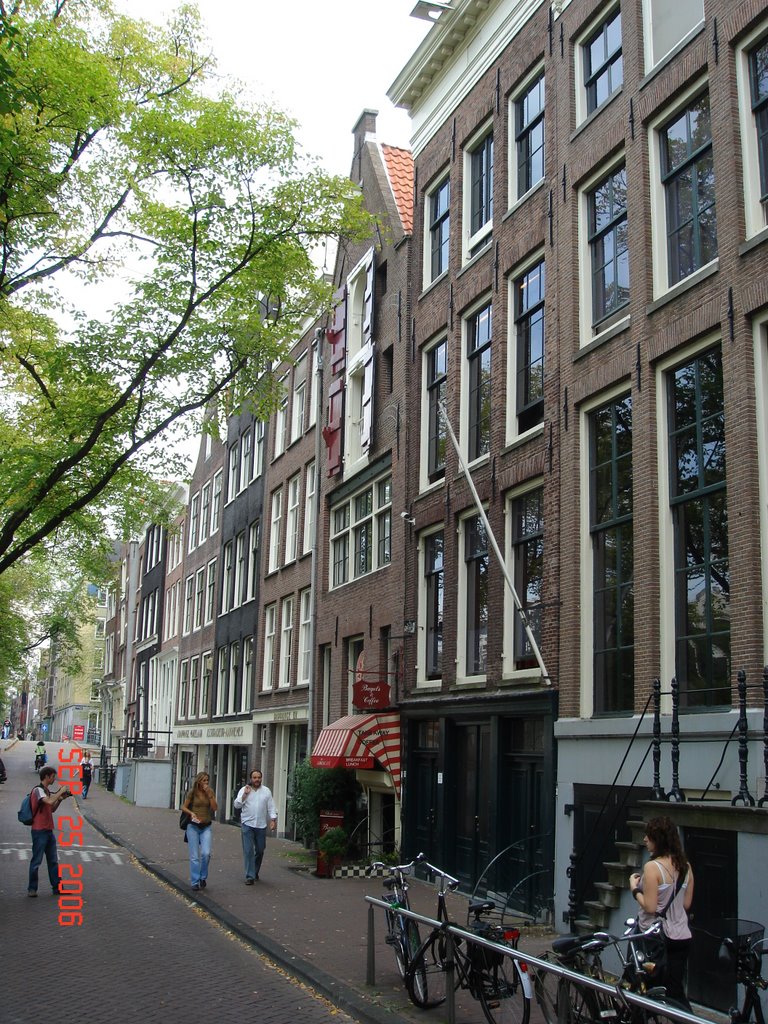
Anne Frank Huis is the building to the right of the red and white awning with dark green trim. At first glance, it looks like any other building on the street.


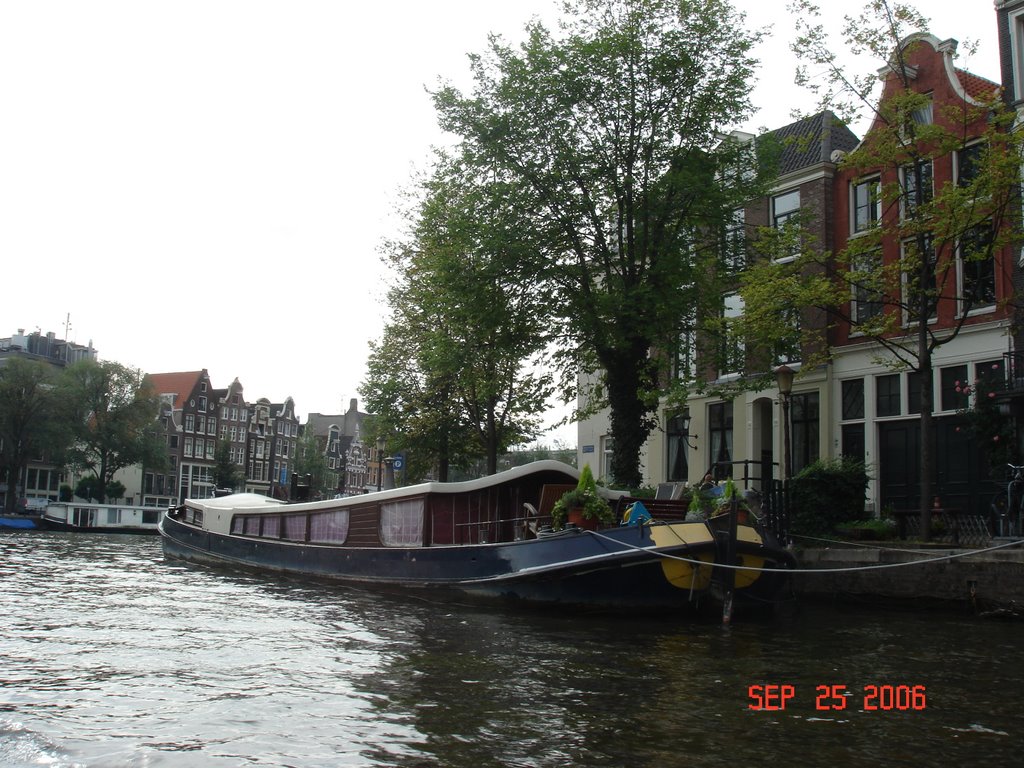
Before we hopped on the boat tour, we did a little more walking. Amsterdam consists more or less of several concentric canals that surround an inland harbor. Because the city sits below sea level, a series of locks was built to prevent flooding. As the city expanded, its residents would simply build another, wider canal around the harbor, much like a tree adds a ring to its trunk as it grows outward. The locks prevent tidal changes in sea level, thereby making the canals very easy to navigate. Countless arched bridges make walking around even easier.


Once on the boat, I was able to snap better photos of the row houses. The buildings you see below are representative of pretty much all of the structures that line the canals. In addition, over 2,000 house boats are tied up along the canals. It’s really great architecture. I’ve definitely never been anywhere like it.